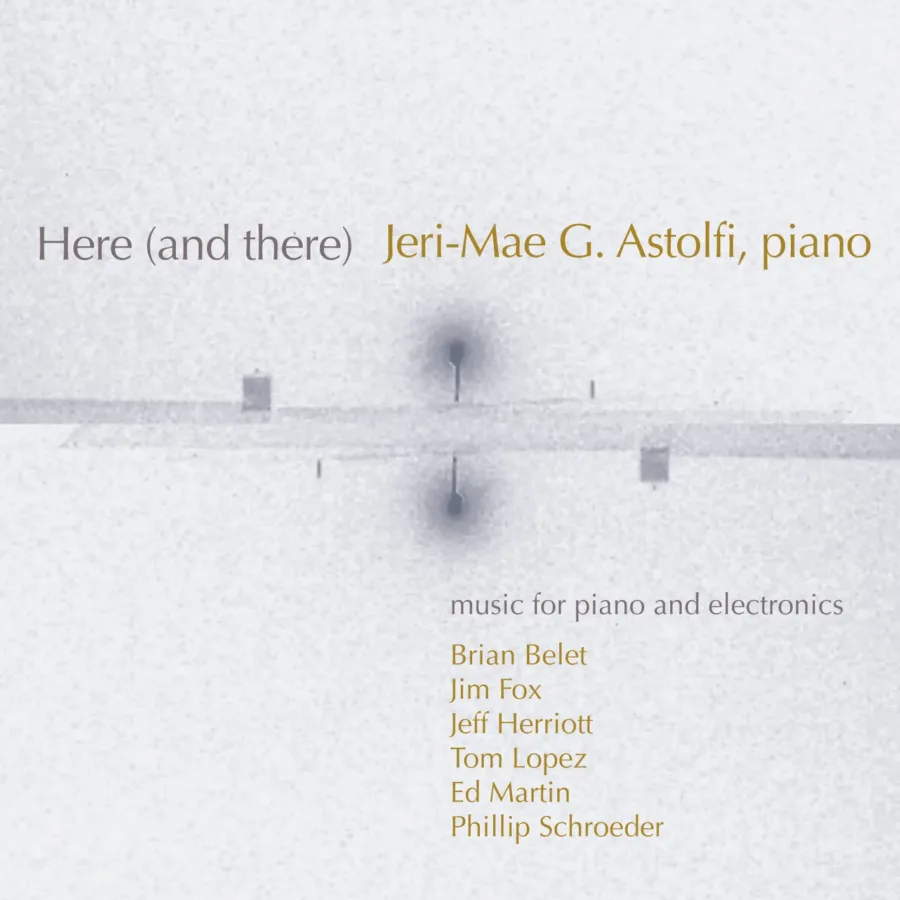
Here (and there)

Description: 
Haunting, drifting music for piano and electronics
Composers: 
Phillip Schroeder
Ed Martin
Jeff Herriott
Brian Belet
Tom Lopez
Jim Fox
Performers: 
Jeri-Mae G. Astolfi
Catalog Number: 
#846
Genre: 
experimental
new classical
electronic
Collection: 
piano
Location: 

Oshkosh, WI

UPC: 
726708684624
Price: 
$15.00
Release Date: 
Jan 29, 2013
Liner Notes: 
View
Format: 
1 CD
Here (and There)iTunes Artist's PageiTunes Album Page
Song TitleTimePrice
1.Crystal Springs10:43$-1
2.Swirling Sky06:19$0.99
3.Green Is Passing09:44$0.99
4.Summer Phantoms: Nocturne11:02$-1
5.Confetti Variations18:07$-1
6.The Pleasure of Being Lost13:19$-1

Here (and there)

One Sheet: 

This collection of compositions written for new-music pianist Jeri-Mae G. Astolfi (and for this CD) fully realizes the wonderful synergies available when combining the beauty of unadulterated piano timbres with the expressive possibilities of their enhancement by electronic means. Astolfi performs the six works on this album with sterling technique and a great affinity for the varied stylistic intricacies of the pieces. 

The music: “Crystal Springs,” composed by Phillip Schroeder (who also produced the album), seamlessly combines electronically manipulated sounds from electric bass, suspended cymbal, and the inside of the piano with seductive motifs drawn from the Fibonacci series. “Swirling Sky,” a micro-tonally enlivened piece by Ed Martin, takes its inspiration from the infinitely mutable patterns of clouds adrift in the sky. Jeff Herriott’s “green is passing” treats an elegantly stripped-bare stream of piano music with subtly varying amounts of reverb. Brian Belet’s “Summer Phantoms: Nocturne” incorporates processed string scrapes, hand-dampened tones, soundboard strikes, and other expanded piano tones with traditionally performed material to create a spectral, sometimes ominous work. Tom Lopez’s “Confetti Variations” wildly combines Feldman and Brahms with an unexpected collage of fascinating field recordings, including fireworks. Jim Fox’s “The pleasure of being lost” closes the album with the haunting intimacy of the human voice, placing a text he freely adapted from the journals of nineteenth-century naturalist and world traveler Joseph Dalton Hooker alongside drifting moments of piano music and electronically processed sounds.

Jeri-Mae G. Astolfi is a Canadian-born pianist whose playing has been lauded as “brilliant” (New Music Connoisseur), “persuasive” (Sequenza21), and “beautiful” (American Record Guide). Her repertoire, ranging from the Renaissance era through the present, clearly affirms her keen interest in new music, which has led her to commission and premiere many new solo and collaborative works. The recipient of numerous awards and grants, Astolfi’s passion for new music has been recognized by invitations to many regional, national, and international music forums, where she has premiered and lectured on new piano music. Astolfi also frequently serves as a piano clinician, coach, and master class instructor. Astolfi currently serves on the music faculty of the University of Wisconsin Oshkosh.

Reviews: 

MODISTI
“[Q]uite melodic and vivid … Great work, great execution.” [FULL ARTICLE]

CLASSICAL-MODERN MUSIC REVIEW
"Jeri-Mae G. Astolfi has an extraordinary presence, a brilliance, that goes a long way to making this an outstanding program." [FULL ARTICLE]
Greg Edwards

MAINLY PIANO
"Astolfi is the rare artist who seems as comfortable with traditional classics as she is with this much more experimental music. … [A]stonishing pianism … and her recordings never fail to impress. If you are looking for a unique listening experience, check out Here (and there)." [FULL ARTICLE]
Kathy Parsons

TEXTURA
"[Here (and there)] provides an excellent example of what can happen when a pianist of Astolfi's calibre explores the sonic possibilities that electronic enhancements can bring to a compositional work. … [C]rystalline strums … lend ['Crystal Springs'] an incandescent and even ethereal air. 'Swirling Sky' … achieves a density that at times verges on overwhelming. [P]rocessed string scrapes, hand-dampened tones, soundboard strikes, and other expanded piano tones function as an integral part of ['Summer Phantoms: Nocturnes'] cryptic sound-world." [FULL ARTICLE]

ARRAY (INTERNATIONAL COMPUTER MUSIC ASSOCIATION)
"[A]n enticing suite of ‘small pieces’, each touching us emotionally, and uniquely commenting on strategies for managing the boundary between live and recorded human performers and programmed machines. … [In 'Crystal Springs,'] the piano part swirls with delicate Fibonacci pitch sequenced elements, sweetly ascending/descending phraseology with oddly ‘jazz like’ tonality; cymbal samples and inside piano strumming remain subtle … [In 'Summer Phantoms: Nocturne,'] the pianist, sensing an opening to expose human musicianship, stylistic instincts and what had been till now a pent up heart energy, is freed to steer the musical direction toward a cadence, with a clear path to a crescendo. … [In 'The pleasure of being lost,'] the intimacy of the voice, the occasionally sensual images, interwoven with moments of physical details of the body’s journey in the physical plane, amidst the heart’s sacred path toward eternity, become mesmerizing, contemplative and reach a climax of understanding as to the profound meaning and meaninglessness of what we experience within and without." [FULL ARTICLE]
Robert Spalding Newcomb